Six takeaways for freight forwarders from our interviews with two FIATA presidents at the 2026 FIATA World Congress in Milan.
At the 2026 FIATA World Congress in Milan, which marked 100 years of FIATA, the International Federation of Freight Forwarders Associations, GFWE co-founder Veronica sat down with two people who have led the federation: Prof. Dr Thomas Sim, President of FIATA for 2025–2027, and Basil L. S. Pietersen, President of FIATA from 2019 to 2021.
We asked them the questions forwarders ask us most: how fast the industry is changing, whether AI will replace forwarders, why anyone should join a network, and what makes a career in logistics worth choosing. Here are six takeaways, in their own words. Quotes are taken from the interview subtitles and lightly edited for filler words and grammar; the full wording is in the videos. The views are the speakers’ own.
You can watch every conversation in our report from the congress.
1. Change is measured in years, not decades
Asked about the next five to ten years, Prof. Dr Sim pushed back on the timeframe itself.
“You don’t even have to look for five to 10 years, because this industry actually develops very fast. Nowadays, technology moves very fast: in one year, two years, totally different.” Prof. Dr Thomas Sim
He named three forces at work at the same time: digitalization, sustainability and the fragmentation of trade around the world. The practical lesson for forwarders: a five-year plan is no longer enough.
2. AI rewards forwarders who transform
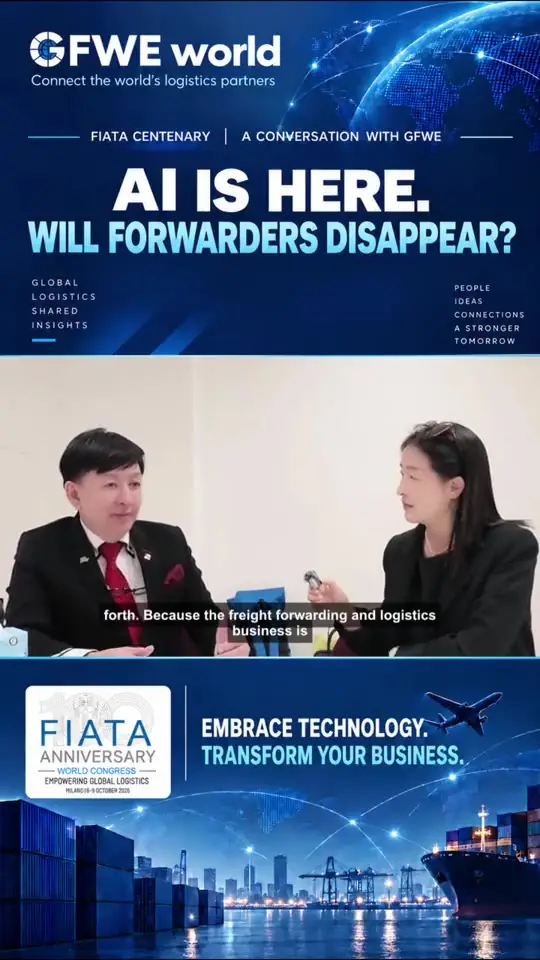
Will AI make forwarders disappear? Not the ones who use it, he argued.
“The freight forwarder of the future needs to transform themselves and engage technology positively, so that they could actually leverage the benefit and productivity of technology like AI and robotics.” Prof. Dr Thomas Sim
Because forwarding covers so much, from warehousing and trucking to first mile, last mile, e-commerce and international freight, there is room for generative and agentic AI almost everywhere. More productivity means lower costs. His warning was blunt: “Those who don’t make this positive change will have problems.”
3. Small and medium forwarders feel the change most, and need a collective voice
Prof. Dr Sim was clear about who carries the most risk: “The changes will be massive for organizations, especially small and medium size. They need to innovate, to think about new ways to digitalize using AI and other technology, to actually improve their business performance.”
Mr Pietersen added why no small forwarder should face that alone:
“When you’re alone, you stand alone. You don’t really have the power to go and negotiate. But when you are in an association, where we all come together, 10 works better than one.” Basil L. S. Pietersen
When forwarders speak to a government or an authority together, he said, “everybody starts listening to you. And that is when you get the results that you require.” Prof. Dr Sim described the same thing at global level: FIATA helps design the transport policy governments implement, and “it represents the voice of freight forwarders globally.”
4. A network has to earn its membership fee
Both leaders returned to the same test for any association or network: real value for members.
“Otherwise, why would someone pay a membership fee and get nothing? There are so many networks they can join, maybe a few hundred networks in the world. … So you must make yourself unique. Bring the value to the members.” Prof. Dr Thomas Sim
His examples of value were practical: training, technology and payment systems. Mr Pietersen put it in one word, relevance: “You have to be relevant to your members. Otherwise, they don’t need you.” Members, he said, need to know “that we can come to you for the advice, for the assistance that we need, for the professionalism that we need.”
5. A 100-year industry that keeps coming back
Mr Pietersen admitted the pressure is real: geopolitics and the speed of AI “make life very, very difficult.” But he sees the centenary itself as the strongest argument for optimism.
“This is the only industry that has survived throughout many, many different stages. … Having gone through both the civil wars, gone through world wars, gone through COVID, and here we are. So yes, I believe that there is a great future ahead for the next generation of freight forwarders.” Basil L. S. Pietersen
“I am quite confident that whatever lies ahead, this industry will survive anything that there is,” he added.
6. Logistics is a career worth choosing
Mr Pietersen entered the industry straight out of university: “I was looking for a job, and this is the job I got.” Decades later, his message to young people and their parents is that logistics sits underneath every other profession.
“If you’re a logistician, you touch every single life. … A lawyer can’t operate if I don’t give him what he needs.” Basil L. S. Pietersen
Today, he noted, “you can go and do the degree, you can go and study to become a logistician,” something his generation had to learn on the job. Prof. Dr Sim gave the simplest reason to stay: “There’s always a different day. There’s no similar day.”
What this means for forwarders in the GFWE network
Two FIATA presidents, two different starting points, one shared message: change fast, work together, and judge any network by the value it actually delivers. That is the standard GFWE holds itself to, with verified members, partner matching, overseas promotion and payment protection designed for small and mid-sized forwarders.
As Mr Pietersen told us when we asked what he would like to see from a young network like ours: “We all have to start somewhere. … As long as there is the tenacity to be sustainable for the future, that is the important thing.”
Less searching. Less waiting. More real business.
GFWE — Find the Right Partner. Faster.
Watch all 11 conversations in our report from the 2026 FIATA World Congress, and see every GFWE meeting on our Events & Global Footprint page.
Written by
Elena
Contributor at GFWE -- Global Freight World E-Alliance