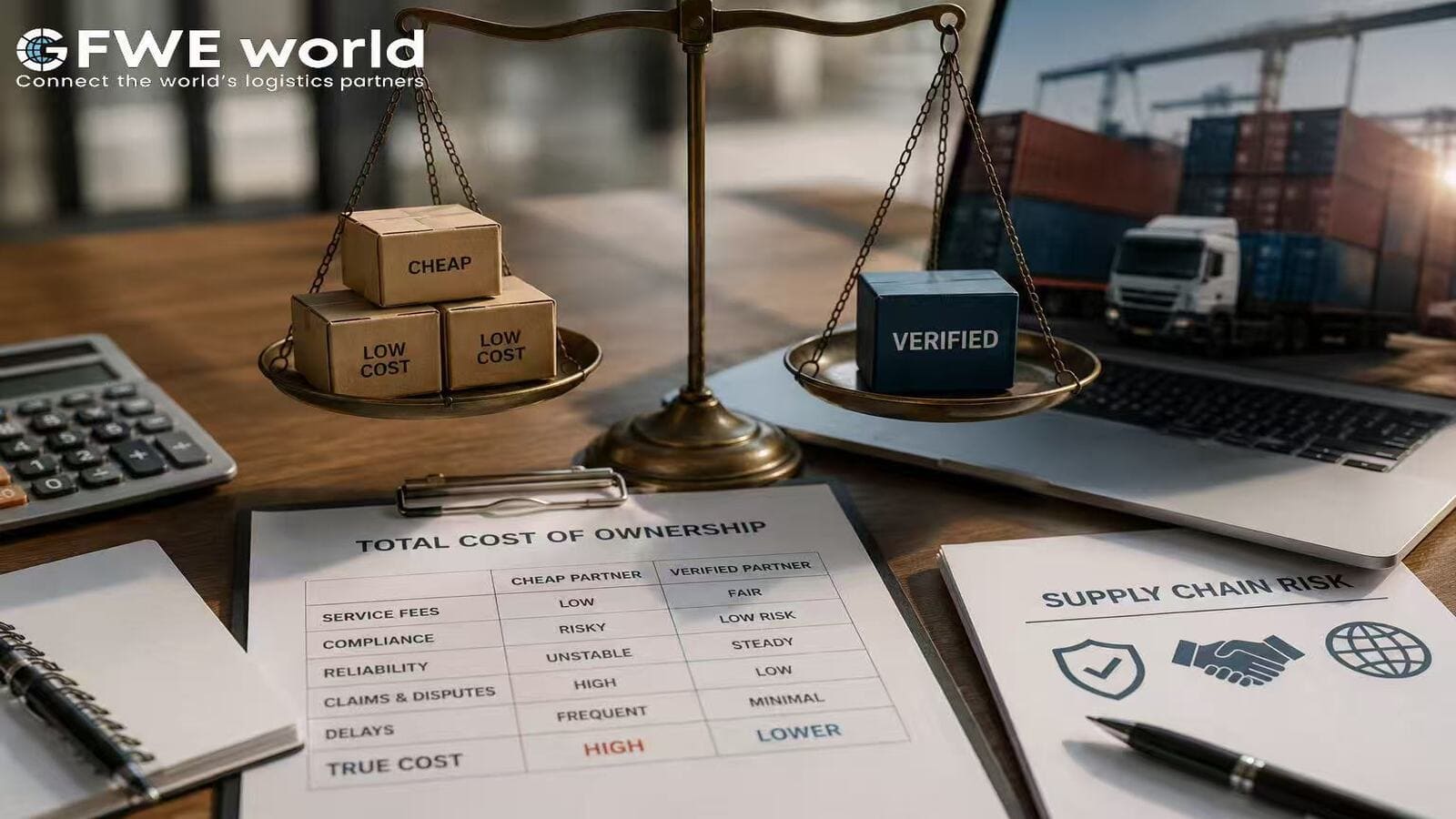
The cheapest partner can become the most expensive mistake you ever make.
Every forwarder loves a good rate. But when choosing a partner, chasing "cheap" over "verified" is one of the most dangerous trade-offs in this industry. Here's why.
The false economy of "cheap"
A low rate looks great — until it doesn't:[^1]
- Cheap can mean cutting corners on service, compliance, or care[^2]
- Cheap can mean instability — a struggling company may not survive the shipment
- Cheap can hide surprise costs that erase your "savings" and then some
- Cheap can mean non-payment risk if the partner is financially fragile[^3]
When a deal is far cheaper than everyone else, ask yourself: what's being sacrificed to get there?
What "verified" actually buys you
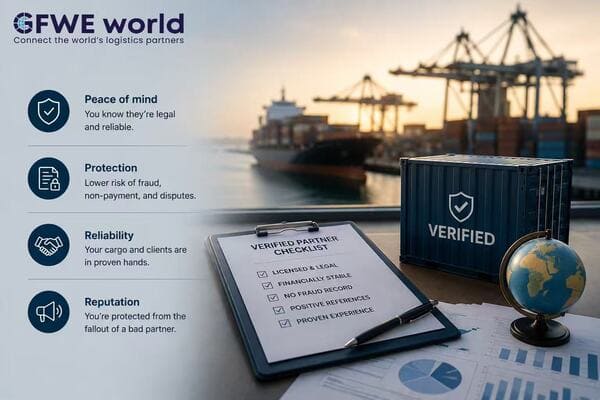
A verified partner might not be the rock-bottom price — but they deliver what truly matters:
- Peace of mind — you know they're legitimate and stable
- Protection — a lower risk of fraud, non-payment, and disputes[^4]
- Reliability — your cargo and clients are in proven hands
- Reputation — you're protected from the fallout of a bad partner
The real math
Think about the true cost of a "cheap" partnership gone wrong — the opportunity cost behind every "saving":[^5]
- A lost client worth years of business
- Weeks chasing an unpaid invoice[^6]
- Damage to your hard-earned reputation[^7]
Suddenly, the few dollars you "saved" look laughably small.
Price is what you pay. Risk is what you carry. Verified partners lower your risk — and that's worth far more than a slightly better rate.[^8]
Where value and verification meet
This is exactly the philosophy behind networks like GFWE. Instead of a race to the bottom on price, you connect with pre-vetted partners whose reliability is confirmed — so you compete on value and trust, not just cost.
Don't ask "who's cheapest?" Ask "who can I trust?" That's the question that protects your business.
👉 Choose verified over cheap. Find partners you can trust on GFWE.
[^1]: False economy — an action that saves money upfront but leads to greater costs later — Wikipedia: https://en.wikipedia.org/wiki/False_economy [^2]: Regulatory compliance — adherence to laws, regulations, and standards relevant to a business — Wikipedia: https://en.wikipedia.org/wiki/Regulatory_compliance [^3]: Credit risk — the risk that a counterparty fails to meet its financial obligations, including non-payment — Wikipedia: https://en.wikipedia.org/wiki/Credit_risk [^4]: Fraud — intentional deception for unlawful or unfair gain — Wikipedia: https://en.wikipedia.org/wiki/Fraud [^5]: Opportunity cost — the value of the best alternative forgone when a choice is made — Wikipedia: https://en.wikipedia.org/wiki/Opportunity_cost [^6]: Bad debt — an amount owed that is unlikely to be recovered — Wikipedia: https://en.wikipedia.org/wiki/Bad_debt [^7]: Reputation — the beliefs and opinions held about an entity; a key business asset — Wikipedia: https://en.wikipedia.org/wiki/Reputation [^8]: Risk management — identifying and minimizing risk, e.g. by choosing verified over cheap partners — Wikipedia: https://en.wikipedia.org/wiki/Risk_management
Written by
Elena
Contributor at GFWE -- Global Freight World E-Alliance