A handshake feels friendly — until something goes wrong. When it does, the only thing that protects you is what's written down. Here's what every forwarder should understand about agreements.
Clear agreements are the backbone of professional freight partnerships. Here's what you need to know to protect yourself.
Why written agreements matter Verbal agreements and assumptions are where disputes are born. A clear written agreement:
Defines exactly what each party will do Sets expectations on payment, timing, and liability Provides a reference point when disagreements arise Protects both parties fairly If it's not written down, it doesn't really exist.
Key elements every agreement should cover
-
Scope of services Precisely what services are being provided — and what's not included.
-
Payment terms
How much, in what currency When payment is due What happens with late payment
- Liability and responsibility
Who's responsible if cargo is damaged or lost Liability limits Insurance requirements
-
Roles and responsibilities Exactly who handles what at each stage of the shipment.
-
Dispute resolution How disagreements will be handled, and under which jurisdiction.
-
Terms and termination Duration of the agreement and how either party can end it.
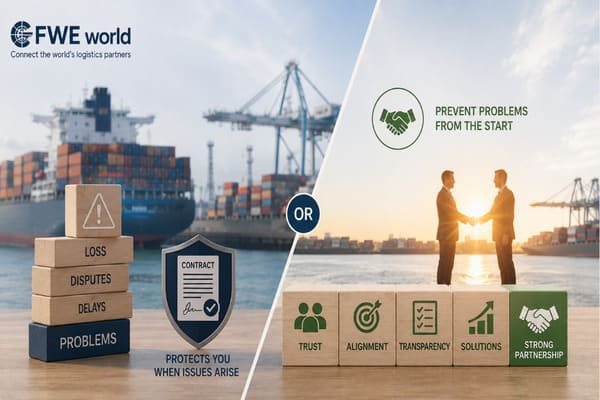
The limits of a contract Here's a hard truth: a contract is only as good as the partner who signs it. A solid agreement gives you a legal remedy — but chasing an unreliable or fraudulent partner through international courts is slow, costly, and often futile.
A contract protects you after things go wrong. It's far better to work with a partner who won't let them go wrong in the first place.
The best protection: a good contract and a trusted partner The strongest position combines both: a clear written agreement and a partner you can genuinely trust to honor it. A handshake feels friendly — until something goes wrong. When it does, the only thing that protects you is what's written down. Here's what every forwarder should understand about agreements.
Clear agreements are the backbone of professional freight partnerships. Here's what you need to know to protect yourself.
Why Written Agreements Matter
Verbal agreements and assumptions are where disputes are born. Clear, written contracts are widely recognized as essential to preventing costly commercial disputes [^1]. A clear written agreement:
- Defines exactly what each party will do
- Sets expectations on payment, timing, and liability
- Provides a reference point when disagreements arise
- Protects both parties fairly
If it's not written down, it doesn't really exist.
Key Elements Every Agreement Should Cover
1. Scope of Services
Precisely what services are being provided — and what's not included.
2. Payment Terms
- How much, in what currency
- When payment is due
- What happens with late payment
3. Liability and Responsibility
- Who's responsible if cargo is damaged or lost
- Liability limits
- Insurance requirements
4. Roles and Responsibilities
Exactly who handles what at each stage of the shipment. Standardized trade terms such as Incoterms clarify where responsibility and cost pass between parties [^3].
5. Dispute Resolution
How disagreements will be handled, and under which jurisdiction. International arbitration is often faster and more enforceable than cross-border litigation for commercial disputes [^4].
6. Terms and Termination
Duration of the agreement and how either party can end it.
The Limits of a Contract
Here's a hard truth: a contract is only as good as the partner who signs it. A solid agreement gives you a legal remedy — but enforcing judgments across borders is notoriously slow, costly, and uncertain [^5]. Chasing an unreliable or fraudulent partner through international courts is often futile.
A contract protects you after things go wrong. It's far better to work with a partner who won't let them go wrong in the first place.
The Best Protection: A Good Contract and a Trusted Partner
The strongest position combines both: a clear written agreement and a partner you can genuinely trust to honor it.
That's why starting from a verified network like GFWE matters so much. Membership in a vetted professional network adds a layer of accountability and credibility between trading partners [^6]. When you connect with pre-vetted, reputation-accountable partners, your contract becomes a formality that reinforces trust — not your only line of defense against a stranger. You get the legal protection and the peace of mind.
Sign smart contracts. But sign them with trustworthy partners.
👉 Contract with confidence. Find trusted partners on GFWE.
References
[^1]: McKinsey & Company — Risk & Resilience Insights: https://www.mckinsey.com/capabilities/risk-and-resilience/our-insights [^2]: UNCTAD — Transport and Trade Logistics: https://unctad.org/topic/transport-and-trade-logistics [^3]: International Chamber of Commerce (ICC) — Incoterms Rules: https://iccwbo.org/business-solutions/incoterms-rules/ [^4]: International Chamber of Commerce (ICC) — Arbitration: https://iccwbo.org/dispute-resolution/dispute-resolution-services/arbitration/ [^5]: The World Bank — Trade: https://www.worldbank.org/en/topic/trade [^6]: FIATA — International Federation of Freight Forwarders Associations: https://fiata.org/ That's why starting from a verified network like GFWE matters so much. When you connect with pre-vetted, reputation-accountable partners, your contract becomes a formality that reinforces trust — not your only line of defense against a stranger. You get the legal protection and the peace of mind.
Sign smart contracts. But sign them with trustworthy partners.
👉 Contract with confidence. Find trusted partners on GFWE.
Written by
Elena
Contributor at GFWE -- Global Freight World E-Alliance