New markets mean new revenue — but also new risks in places you don't fully understand. Here's how to expand with ambition and caution.
Growth means entering new markets. But unfamiliar territory brings unfamiliar dangers. Here's how smart forwarders expand safely.
1. Do Your Homework First
Before entering a new market, understand:
- Local regulations and customs procedures
- Market demand and competition
- Cultural and business norms
- Common risks and challenges
Understanding local regulatory and customs requirements is fundamental to entering any new trade market [^1]. Knowledge is your first line of defense.
2. Start With a Reliable Local Partner
This is the single most important step. A trusted local partner gives you:
- On-the-ground expertise you can't get from research
- Established infrastructure and relationships
- A guide through local pitfalls and regulations
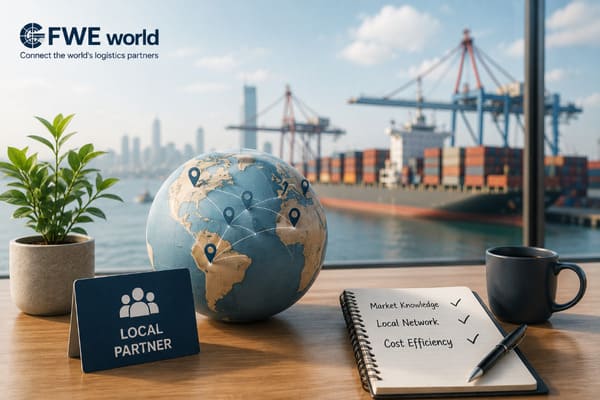
Local partners provide market knowledge and established networks that are difficult and costly to build from scratch [^2]. Trying to enter a new market without a competent local partner is the fastest way to fail.
3. Test Before You Scale
Don't bet everything on day one. A phased, test-and-learn approach helps companies reduce the risk of market-entry decisions [^3]. Start with smaller shipments, prove the lane works, build confidence, and then scale up. Let success guide your expansion.
4. Manage the Partner Risk Carefully
Here's the danger: in a new market, you have no relationships and no reputation to rely on. How do you find a trustworthy local partner when you don't know anyone?
Assessing counterparty and third-party risk is one of the biggest challenges when operating in unfamiliar markets [^4]. This is where forwarders get burned — handing cargo and money to unvetted strangers in unfamiliar places.
5. Protect Your Reputation
Your clients trust you, regardless of which market you're operating in. A partner's failure reflects directly on your own reputation and client relationships [^5]. A bad local partner damages your name. So the quality of your partners directly protects your reputation.
The Safe Way to Enter Any Market
The key to safe expansion is solving the partner problem — and that's exactly where verified networks like GFWE become invaluable.
Instead of arriving in a new market blind, you connect with a pre-vetted local expert who's already been screened for legitimacy, competence, and reputation. Membership in a vetted professional network gives you access to accountable, credible partners across markets [^6]. You get instant on-the-ground expertise from someone the network has already vouched for — turning risky expansion into confident growth.
Expand boldly. Just don't expand blindly.
👉 Enter new markets with a trusted partner already waiting. Explore GFWE.
References
[^1]: World Trade Organization (WTO) — Trade Facilitation: https://www.wto.org/english/tratop_e/tradfa_e/tradfa_e.htm [^2]: McKinsey & Company — Strategy & Corporate Finance Insights: https://www.mckinsey.com/capabilities/strategy-and-corporate-finance/our-insights [^3]: Harvard Business Review — Build Your Strategy Around What You Don't Know: https://hbr.org/2014/06/build-your-strategy-around-what-you-dont-know [^4]: McKinsey & Company — Risk & Resilience Insights: https://www.mckinsey.com/capabilities/risk-and-resilience/our-insights [^5]: Harvard Business Review — Reputation and Its Risks: https://hbr.org/2007/02/reputation-and-its-risks [^6]: FIATA — International Federation of Freight Forwarders Associations: https://fiata.org/
Written by
Elena
Contributor at GFWE -- Global Freight World E-Alliance